We Own Nothing Anymore: Subscriptions Are Stealing Our Culture, Our Tools, and Our Autonomy
 Temps de lecture/Reading time : 4 minutes
Just ten or fifteen years ago, buying a film, an MP3 album, a piece of software, or a plug-in was simple:
you paid, you downloaded, you owned it.
Today, that world is vanishing before our eyes.
Quietly, the cultural and digital industries have pushed us into a new logic: we no longer own anything. We rent everything.
And this shift is not harmless. It may be the biggest disruption in digital culture since the invention of the MP3.
It’s time to open our eyes.
The Subscription Model: A Brilliant Trap Disguised as Convenience
Tech giants first presented subscriptions as a miracle solution:
- unlimited access
- low monthly cost
- automatic updates
- multiple-device compatibility
On paper, it sounds great.
In practice, it’s a well-designed trap.
A system where we trade freedom for convenience.
Where we give up ownership in exchange for temporary access.
Where we become dependent on services we do not control.
Because behind the promise of “everything, anytime,” lies a brutal truth:
a subscription is not a purchase. It is a rental.
And in a rental, you are never the owner.
The Roland/Boss Example: Even Guitar Pedals Are Becoming Cloud Prisoners
Let’s take a concrete and revealing example: Boss pedals.
Boss is part of musical culture — the DS-1, the CE-2, the DD-7… iconic, robust, timeless machines.
When Roland announced plug-in versions of these pedals, musicians were excited: the Boss sound in a DAW, without compromise.
But the reality?
Roland locked these plug-ins behind — you guessed it — a subscription.
No one-time purchases. No perpetual licenses.
Just a cloud, a monthly fee, a conditional access.
To use a single virtual pedal, a musician must:
- subscribe to a service they don’t need
- accept losing access if they stop paying
- depend on a centralized platform for a work tool
Boss is far from alone.
Waves, Slate Digital, Adobe, Avid, Autodesk, even ChatGPT…
All are pushing toward the same model: perpetual rental.
The New Face of Digital Capitalism: Capturing the User
This shift is no coincidence.
It fits a clear economic logic: a trapped user is worth more than a free customer.
When you buy software, the company earns money once.
When you rent software, it earns money every month, forever.
This is the subscription economy, and companies love it.
But for users, it amounts to slow, organized dispossession.
We are no longer buyers.
We are recurring revenue streams.
It’s the same mechanism as smartphones: glued batteries, proprietary parts, restricted repairs — all to keep you locked inside an ecosystem.
Subscriptions are the digital equivalent of this cage.
The Great Illusion: “You Have Access to Everything”
Another subtle manipulation often heard:
“With a subscription, you get access to thousands of items — it’s better than buying.”
But this so-called “unlimited access” depends on three fragile conditions:
- the company must continue to exist
- it must maintain its catalog
- you must keep paying indefinitely
This is conditional, revocable access.
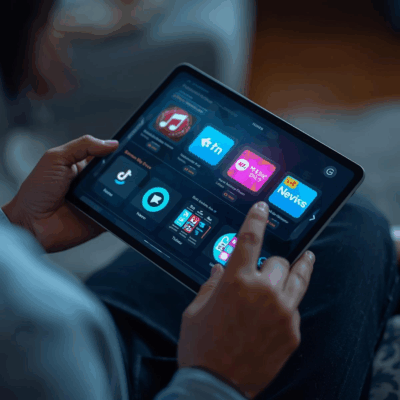
We assume Spotify, Netflix, or Apple Music will last forever.
But who predicted the fall of:
- MySpace?
- MSN Messenger?
- Vine?
- Grooveshark?
- Nokia?
- BlackBerry?
- Flickr?
- Google+?
- Deezer Elite (discontinued)?
Today’s giants can collapse tomorrow, replaced by a new technology, a more convenient system, or an entirely different model.
And when they fall, they will take our digital libraries with them.
Music: The Test Laboratory for a Model Now Spreading Everywhere
The music industry was the testing ground.
Before streaming:
- people bought albums, singles, digital files
- artists sold their work
- users built personal libraries
With streaming:
- users own nothing
- artists depend entirely on platforms
- catalogs can be altered, removed, censored
- music becomes a stream, not a heritage
And now this model is spreading to:
- video
- games
- software
- VSTs
- sound libraries
- sheet music
- images
- AI tools
Everything that used to be downloadable and archivable is becoming a temporary service.
The Danger: We Are Losing Our Cultural Memory
This is perhaps the darkest consequence.
When everything is on the cloud, locked behind subscriptions and temporary licenses, there is no real digital heritage left.
Tomorrow, a company can decide to:
- remove a film due to licensing
- censor a show
- disable an “obsolete” plug-in
- force updates that replace old versions
- increase prices and make you follow
- shut down a service and delete its content
We are no longer masters of what we consume.
We are tenants of our own culture.
If this model continues, we are heading for a world where:
- nothing can be archived
- nothing can be transmitted
- nothing can be preserved
- nothing truly belongs to us
It is a programmed digital amnesia.
Escaping the Trap: Reclaiming Digital Ownership
Several forms of resistance exist.
1. Support Alternative Models
- Buy from platforms that offer perpetual downloads (Bandcamp, GOG, independent developers)
- Choose software with one-time purchases
- Favor VSTs with perpetual licenses
2. Archive, Save, Own
Download, store, and preserve what you can offline.
It’s inconvenient.
But it’s a political act.
3. Demand Laws Protecting Digital Ownership
Some countries are starting to consider legislation requiring that:
If a product exists, consumers must have the option to buy and keep it.
4. Support Creators Who Resist the Subscription Trend
Musicians, developers, and producers who still sell perpetual licenses need support now more than ever.
Subscriptions Are Not Progress — They Are a Hidden Regression
We live in a strange paradox:
technology gives us access to everything… but takes ownership of everything away.
It opens the door while chaining us to the doorstep.
Subscriptions can be convenient, but they must not become the only option.
Without vigilance, we are heading toward a world where everything is temporary, disposable, locked.
A world where we no longer own our films, our tools, our creations, or our culture.
It is up to us to say:
No. What I pay for, I want to own. I want to keep. I want to control.
The battle for digital ownership has only just begun.