The Era of Easy-to-Consume Video Content: When Algorithms Turn Us Into Clickbait
 Temps de lecture/Reading time : 4 minutes
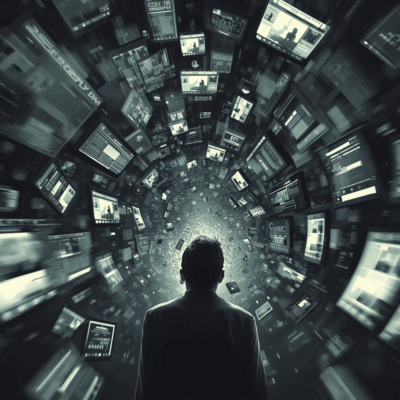
The age we live in could be summed up in a single image: a scrolling finger, endlessly swiping, hypnotized by content that follows one clip after another in the blink of an eye. TikTok, Instagram Reels, YouTube Shorts, even autoplay feeds on streaming platforms… Everywhere, videos are getting shorter, and multiplying, just like our shrinking attention spans. We’ve entered the age of easy-to-consume content: formatted, optimized, and calibrated by invisible algorithms that decide not just what we watch, but how we think—or at least how fast we do it.
But how did we get here? Why are our screens dominated by clickbait titles, exaggerated expressions, and flashy visuals? Are we willing captives in an attention economy that does everything to keep us hooked?
Let’s try to break down this new media era—one scroll at a time.
A New Media Era
More than ever, image is king. A quick, accessible, often musical image filled with expressive faces, bold text, and an emotional punch. In just a few years, the rise of short-form video platforms has reshaped how we consume information, entertainment, education, and conversation.
What YouTube once revolutionized with 10-minute videos, TikTok pushed to the extreme: where ten minutes used to be “short”, now a one-minute clip feels long. Immediacy reigns supreme.
The new law of digital content could be summed up like this:
“Grab my attention instantly, or I’m gone.”
The creator doesn’t have 10 seconds to draw you in anymore. They have just one. This shift is not just a change in behavior—it’s the direct result of something much bigger: the attention economy.
The Attention Economy: Why Everything Has Become Clickbait
Why are we bombarded with aggressive thumbnails, bold headlines, and over-the-top reactions? Why are transitions faster, videos shorter, and emotions louder?
Because we are no longer just spectators – we’re watch time to be sold. Data. Clicks. Moments of brain occupancy.
Big platforms like YouTube, Meta, ByteDance, or X make their money through targeted advertising. Their logic is simple: the longer you stay, the more they earn. Their goal is to maximize what’s called retention—the amount of time you stay hooked on a platform.
Everything on these platforms is built to keep you watching:
- Sensational or misleading titles.
- “Hooks” in the first 2-3 seconds (“You won’t believe what happens next!”).
- Trending sounds remixed a thousand times.
- Infinite feeds that autoplay the next video automatically.
Creators, for their part, don’t have much choice. If they want visibility, they must play by the algorithm’s rules. The result? More and more content becomes standardized, sensationalized—and yes, clickbait by design. Clickbait isn’t an accident. It is the natural outcome of a business model built on attention and emotion.
The Algorithm: Our Digital Narcotic
What exactly happens behind the screen? What does an algorithm really do?
It watches you. It learns. It analyzes everything:
- How many seconds you watch each video.
- Whether you liked, shared, or bookmarked.
- The exact moment you stopped watching.
Every action trains the machine, which personalizes your feed in real time. This isn’t magic—it’s just recommendation systems, often based on “collaborative filtering” or “content-based filtering”. But in practice, it can drag you from a funny dog video to conspiracy theories in just two swipes.
The problem isn’t just what it recommends—it’s that it traps you in a loop, amplifying your emotions and biases. Algorithms reward intensity, not truth. It prioritizes surprise, outrage, shock, and fear… and gradually builds bubbles of content that strip out nuance.
The algorithm is not neutral. It rewards whatever grabs attention—not what makes sense.
Oversimplifying the World: From Knowledge to Instant Opinion
In this context, social issues, current events, and complex topics become raw material for instant opinions. In just a few seconds, we go from “Top 5 reasons to stop eating sugar” to “The real reason [insert celebrity] left [insert other celebrity]”.
This culture of fragments turns knowledge into pixels and punchlines. We no longer read articles, investigative reports, or books—we get snippets, recycled clips, often pulled out of context.
Where it once took time to understand a topic, we now consume outrageously simplified versions, deliberately designed to provoke immediate emotional reactions.
The consequences?
- Critical thinking is fading.
- Empathy and complex thought disappear behind sarcasm and shock.
- Truth and lies blend into a stream of flattened “takes”.
Content Creators: Between Constraint and Opportunity
Creators find themselves caught in a painful dilemma: do they adapt to the clickbait logic, or fade into obscurity? The competition is fierce, and the algorithm doesn’t reward quality—it rewards performance.
To stay visible, many creators optimize everything:
- Titles, facial expressions, body language…
- They mimic trending formats, use identical sounds, or fake emotions.
Yet there is an alternative. More and more creators are embracing long-form formats, thoughtful pacing, or a depth-focused approach. They attract an audience tired of perpetual scrolling. Channels like Nota Bene, podcasts like Thinkerview, or science communicators prove that it’s possible to keep attention and respect audience intelligence.
Newsletters or blogs are also reclaiming space from the algorithmic chaos.
It’s a harder path—but it challenges the core logic of the current media ecosystem.
From Consumer to Product: Our Attention Up for Auction
Let’s come back to us—the viewers. If content becomes clickbait, it’s because we click. We are the fuel of this system.
The truth is cruel but simple:
If it’s free, you are the product.
Our screen time, our behavior, our emotional responses, our location—everything is monetized.
The consequences are real:
- Cognitive dependence – your brain links dopamine to scrolling.
- Shortened attention span – reading a book or sitting through a 10-minute video becomes harder.
- Inner emptiness – fast content leaves us full of noise, but starved of meaning.
We become passive spectators, believing we’re in control—while our time dissolves into forgotten clips.
Toward a New Balance? Solutions, Alternatives, and Awareness
Thankfully, not all is lost.
More voices are rising against this spiral, promoting slow content and healthier digital habits. We see:
- Intentionally long-form newsletters, safe from algorithms.
- Alternative platforms like Substack, Medium, or even Bandcamp for musicians.
- Apps like Forest or Freedom that block distractions.
We do have a choice. To consume less, but better. To reclaim our attention.
Algorithms shape the world far more than we like to think. They influence what we see, think, and believe—until we forget that this world isn’t the world, but a feed carefully engineered.
Are we doomed to a life of viral videos and compulsive clicks? Not necessarily. But resisting means slowing down. Choosing. Taking back control of our attention.
Because at the end of the day, one truth remains:
The time we spend won’t be given back.