The Business Tempo – February 2026: between Algorithms, AI, and the Weakening Ecosystem
 Temps de lecture/Reading time : 3 minutes
Behind growth announcements and technological innovations, February 2026 reveals a music industry under pressure. Streaming is up, vinyl is experiencing a revival, artificial intelligence is everywhere… but so is the precariousness of independent players, dependence on platforms, and the questioning of support for artists.
This month, several strong signals paint a contrasting landscape, where technology is advancing faster than the sector’s ability to ensure sustainable careers.
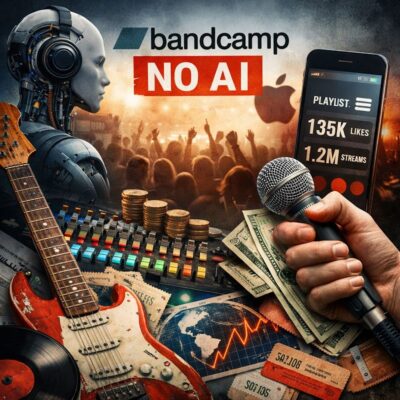
Bandcamp bans AI artists: a rare political act
By deciding to ban artists generated by artificial intelligence, Bandcamp takes a clear stance: defending human creation in an increasingly automated environment.
This choice, praised by many independent artists, highlights a central paradox of today’s industry. While most platforms prioritize quantity, algorithmic optimization, and cost reduction, Bandcamp reminds us that music is not just a stream of data.
But this decision remains isolated. Elsewhere, AI is already integrated into production, promotion, and recommendation, often without any debate on its economic and cultural consequences.
A music economy weakened on the ground
Despite overall market growth, the daily reality is much harder. Managers, independent labels, concert venues, and specialized media operate with extremely thin margins.
Touring, once an economic engine, has become risky:
- exploding logistical costs
- inflation in insurance and transportation
- pressure on performance fees
Local infrastructures, essential for artistic emergence, are among the first victims. Their disappearance weakens the entire music value chain.
Visibility dictated by algorithms
Today, existing musically often means appealing to algorithms. Streaming and social networks dictate formats, publishing rhythms, and even artistic choices.
This logic favors superficial indicators—views, likes, engagement rates—at the expense of artistic depth. Artists are encouraged to produce more, faster, and more legibly for machines, at the risk of turning creation into a permanent optimization strategy.
Disappearance of human support and automation
Independent music journalism, alternative radio stations, alternative revenue opportunities, and certain support professions are in sharp decline.
At the same time, artificial intelligence is gradually replacing human functions: writing, curation, marketing assistance. While these tools promise efficiency and cost reduction, they raise a fundamental question:
“who still supports artists in the long term?“
An industry that remains unequal
Access to the music industry remains deeply unbalanced. Artists from working-class backgrounds, marginalized communities, or outside major urban centers face more economic and technological barriers.
The gap between inclusive discourse and on-the-ground reality is widening. Without concrete investments in training, access to tools, and structural support, artistic diversity risks remaining nothing more than a slogan.
Bandsintown for Artists: tools instead of promises
In the face of this instability, some platforms are betting on pragmatic solutions. Bandsintown for Artists launched a Marketplace at the end of 2025, bringing together more than 30 partner tools.
Objective: help independent artists better structure their activity:
- centralized distribution of tour dates (Spotify, Google, YouTube, Apple Music, Shazam)
- integrated marketing tools like un:hurd
- connection to merchandising stores like Amazon Music or Shopify
- advanced analytics via SymphonyOS
An approach that answers a growing need: regaining control over the relationship with fans.
Apple Creator Studio: professional creation by subscription
Apple strengthens its influence with Apple Creator Studio, a $12.99/month subscription bundling Logic Pro, Final Cut Pro, MainStage, and Pixelmator Pro.
The new version of Logic Pro integrates AI-based features (AI Synth Player, Chord ID, Quick Swipe Comping) and facilitates the transition from GarageBand on iPhone to a complete professional production workflow.
With an offer of $2.99/month for students and teachers, Apple democratizes access to tools… while reinforcing dependence on a closed ecosystem (you know what I think about these subscription systems—see the article).
Market growth: the paradox
According to Will Page’s annual study, the global value of music rights reaches $47.2 billion. Streaming remains the main driver, but physical formats are surprising.
In the UK:
- streaming: +4.2%
- physical sales: +11.5%
- 7.6 million vinyl records sold in 2025 (+13.3%)
Ireland does even better, with +20% for vinyl and a resurgence of CDs and cassettes. A reminder that model diversification remains essential.
February 2026 shows a music industry in full contradiction: innovative but unstable, profitable on paper but fragile on the ground.
Technology is not the problem in itself. The real issue lies elsewhere: rebalancing access, rebuilding human support, and restoring value to long-term creation and artists.
Changing the tempo is no longer enough.
It is time to rewrite the score.